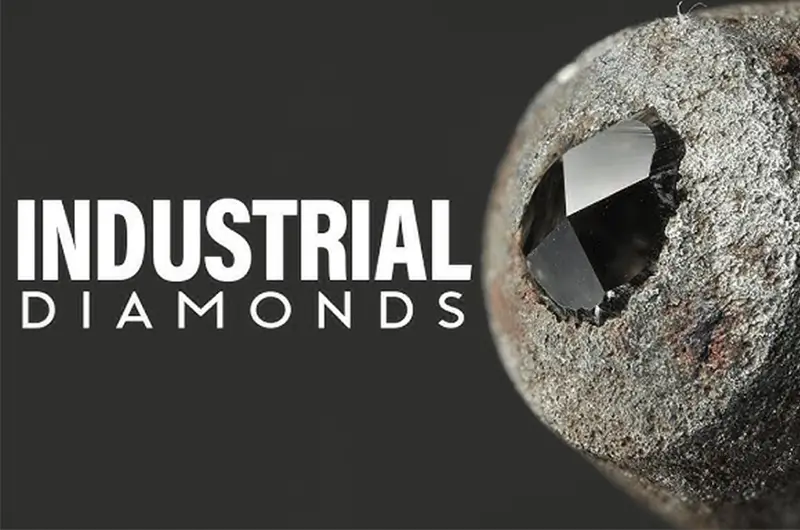
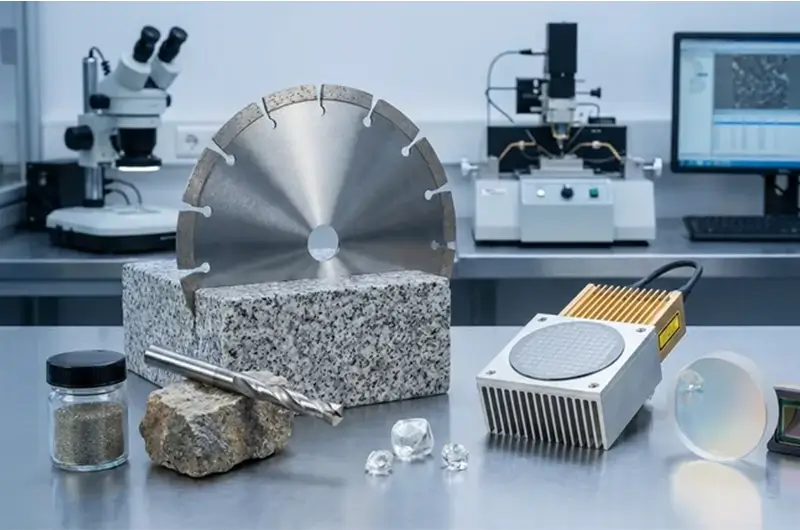
Industrial diamonds are uncut and junior to quality of gem-grade lab diamonds, accounting for about 80% of all diamonds engineered by weight and 30% by value. Synthetic diamonds cover a broad spectrum of applications in satellite thermal cooling, powers, EV charging and quantum sensors in addition to being set into ornamental jewelry. Due to exceptional hardness and thermal conductivity, industrial diamonds are utilized in many industrial diamond tools like industrial diamond cutting tool, diamond heat spreaders, diamond tipped saw, wear-resistant components, etc.
Mechanical Fields
Lab grown diamonds, known as “Industrial Teeth”, are often go-to solutions in many industrial occasions for unmatched hardness, durability, thermal conductivity and quality consistency.
Cutting, Grinding, and Drilling
Diamond-coated saws, bits and wheels sustain stable performance over a longer lifespan in hardened material machining in aerospace, automative and even construction. Mechanical machining poses touch requirements to material hardness and abrasive resistance. CVD diamonds prevail across most industrial applications than HPHT diamonds for five intrinsic technical merits:
- Catalyst-free vacuum environments deliver ultra-high purity Type IIa diamond, achieving seamless compatibility with satellite thermal sinks, EV charger heat spreaders and high-power laser optics;
- Flexible CVD growth enables unlimited customization of diamond forms like large-area single-crystal wafers, thin diamond films and conformal coatings on complex tool geometries;
- Precise doping of boron or nitrogen in the gas phase of CVD steers insulating diamonds to functional electronic and optical media;
- Continuous and seamless coating form atomic bonds with carbide tool substrates, endowing cutting tools with superior wear resistance and longer service life;
- Compact low-pressure vacuum CVD reactors are prone to upgrade, being well-matched to cutting-edge fields like aerospace, quantum technology and power electronics.
Nanoscale Precision Machining
Synthetic diamonds outperform other materials in nanoscale precision machining due to definitive technical metrics. Ultra-sharp cutting edges with edge radius within 2-5nm can be fabricated by viable tools equipped with single-crystal and CVD diamonds. Single point turning diamond achieves ultra-smooth surfaces within an Ra bandwidth of 0.1–0.6 nm.
Such tough requirements on precision and roughness are completely impossible for alternative materials like PCD or PCBN. Ultra-high precision carries equal significance in electronics and high-end optics. Even a minor defect or slight deviation matters in precision machining of delicate components. Superior precision attainable via lab grown diamond tools qualifies such tooling the optimal material in occasions where precision is paramount.
Wear-Resistant Components & Industrial Abrasive Media
Superior wear-resistant properties of lab grown diamonds determine their two primary applicability as wear-resistant components and industrial abrasive media. They are shaped into coatings and materials to resist wear and abrasion in applications where frictional contacts among components (cutting and grinding tools) are high or processes last long (gas, oil and construction).
Lab grown diamond abrasives are essential in high-precision applications like optics, semiconductors and electronics, etc. Controllable grain size, morphology, impurities and superior thermal conductivity cut mass productions costs 30-60% in lapping, polishing and grinding workflows. Unparalleled thermal conductivity dissipates frictional heat in processing, lowering risks of thermal damage, workpiece deformation and surface microcracks.
Advanced Heat Dissipation Solutions
Efficient heat dissipation of electronics sustains stable device operation throughout prolonged durations.
Speed Up Heat Dissipation in AI Industry
It’s obvious in emerging AI industry, in which a date center heats up upon users ask AI questions. Bigger AI data center means superior heat dissipation proficiency. Lab grown diamonds are growing into premium heat-dissipating materials in elevating the ceiling for heat dissipation.
One modern AI chip turns to a tiny-space heater in complicate math calculations. Thousands of such packed chips in data center run billions of calculations a second, and each of them throw off heat. Each existing advanced AI accelerator draws 700-1000 watts and a new upgraded version is projected to over 2000 watts. Thermal build-up acts as the bottleneck restricting the full potential of computational throughput. Hot chips slow down themselves for thermal throttling while excessive heat buildup poses risks to safety as well. Research data indicates that diamond conducts heat 5 times faster than copper. Temperature drops 10-15 °C when diamond is applied to a GPU.

Attributes of Diamond-on-Copper or Diamond-on-Silicon Composites
Core objectives of developing composite materials lie in binding the finest attributes of different materials together. Cutting-edge diamond-on-copper or diamond-on-silicon composites represents the latest breakthroughs in microelectronics packing. In addition, they work in the latest wireless communication systems and electric vehicle power systems. All above advances allow manufacturers creating more compact electronics while not compromising on heat dissipation.
Semiconductor & Electronic Uses
Wide-Bandgap Semiconductor
Diamond, classified as a wide-bandgap semiconductor, exhibits superior thermal conductivity exceeding that of every other bulk solid, transferring heat far quicker than metallic materials. It also bears superior tolerance to higher voltages alongside robust anti-radiation properties, being ideal for power, RF, space, and defense electronics.
Transistors and Diodes
Man-made diamonds have long held promise in creating new electronic devices for its exceptional properties. Successful strides have been made in diamond-based field-effect transistors and diodes, staying well-functioned under high-temperature and voltage conditions.
Quantum Technology
Quantum sensing and computing is one of a futuristic research direction of diamond. Create a nitrogen-vacancy (NV) center by placing a nitrogen atom next to a gap in the carbon lattice. De facto, an atom serves as a controllable quantum bit. It responds to minuscule variations in magnetic field, temperature and pressure under laser irradiation.
NV-diamond works at room temperature while most quantum devices work at near absolute zero only. It’s built into ultra-sensitive magnetometers and navigation aids just for this reason. NV centers are taken as a leading frontrunner for room-temperature solid state qubits. They can detect tiny fluctuation of magnetic field triggered by a single heartbeat.
Emerging Applications in Medical Tools & High-Pressure Science
In addition to above referred industries, lab diamonds are viable for applications requiring tough, pure and pressure-bearing stable materials, such as long-lasting surgical or medical tools and sensors that are safe for implantation inside living tissues, laboratory chambers that simulates extreme pressures deep within planets, and quantum sensors that are sensitive to magnetic signal of a single cell.
Medical and Surgical Apparatuses
A diamond edge keeps sharp longer than metallic material. That’s why diamond-coated scalpels and dental burs are popular in certain conditions. They achieve superior cutting precision while featuring extended service intervals between replacements. In addition, lab diamonds are biocompatible and inert in chemical. The chemical inertness makes them one of premium options for implantable sensors and electrodes.
High-Pressure Research and Science
A diamond anvil cell is capable of withstanding ultra-high pressures on a benchtop. So it’s possible to compress a miniature sample between two diamond tips. Observers are able to crush a sample and see what happens through a diamond medium for its supreme hardness and transparence.
More and more lab grown diamond manufacturers or lab grown diamond supplier devotes research and innovative efforts to push the boundaries of industries. Try to make milestone strides by virtue of lab diamonds’ chemical, physical and optical properties. Due to production cost declining and technical breakthroughs, such revolutionary carbon materials are redefining the precision ceiling of modern industries.