Brightness, sparkle and unparalleled value for money are driving forces of surging demand in lab grown diamond over the last decades. Excellent cutting technique is indispensable in the purpose of premium 4C grade, being the most important “C” dominating appearance of lab diamonds. Average consumers’ initial perception of “cut” involves the shape of lab diamonds rather quality. As a factor impacting value of diamonds, cut determines a diamond’s fire, sparkle and brightness to a great extent. Dig deeper into diamonds through anatomy of diamond.
Different Parts of Diamonds and Corresponding Terminology
Man-made diamonds adopt same cutting standards alongside mined diamonds. Therefore, their anatomical components conform to the same set of naming framework. Diamond part name is up to cut shapes, not diamond origions. Get a quick overview of round brilliant lab diamonds via the diagram below:
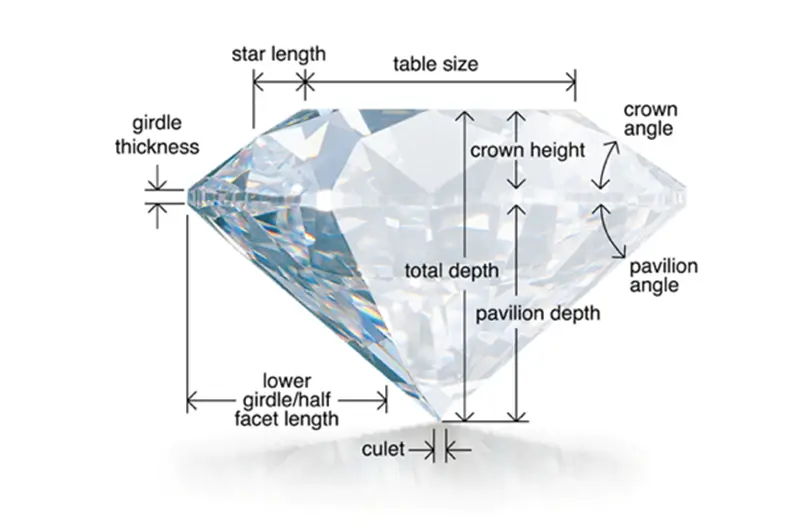
There is no doubt that any single proportion of diamonds is not indicative of cutting grade. Overall appearance of diamonds arises from the collective contribution of all cut proportions. Specific cutting grade means all paramenters ought to fail within a predetermined numerical range. Adverse interaction among parameters probobaly lower the cutting grade of a diamond.
Table
The table refers to the largest horizontal facet on the top of a diamond. The table size is rendered in percentage form of a diamond’s average girdle diameter. A diamond assigned as Excellent cut grade boasts a 52-62% table size; other parameters like crown height, pavilion depth, girdle, culet proportions, polish and symmetry are all aspects that need to be considered.
Crown
Crown refers to the upper proportion from the top facet to the girdle. Its height is also denoted in the form of percentage relative to the average girdle diameter, being an influencial factor in light dispersion and brilliance. The crown angle refers to the degree of separation between the girdle plane and the bezel facets. Ideal range of crown angle for a round brilliant diamond spans from 32° to 35°. Extreme high (>36°) and low angle (<31.5°) sacrifice a diamond’s colorful sparkle and brilliance respectively.
Star length of a diamond refers to the projected distance in horizontal from the point of star facet to the edge of table. It’s rendered as a percentage of the total vertical span from the table rim to the girdle. Ideal star length falls within 40 ~ 55% in typical; longer or shorter star length disruputs the equilibrum between light dispersion and light return. In a word, longer star length amplify colored light dispersion while shorter star length elevate white light return. This creates a trade-off between fire and brilliance; improving one optical performance metric comes at the cost of the other.
Girdle
Girdle of a diamond is the widest narrow section separating the crown from the pavilion, functioning as the setting edge in contact with the ring mount and the bearing surface for microscopic laser engraving of certification numbers. A thick girdle add weight to the least important position and diminish the perceived size in visual; on the contrary, thin girdle is susceptible to chipping in daily wear or setting process.
Diamond half facet length, aka lower girdle facet length, is expressed as a percentage, representing the ratio of the projected distance of lower girdle facets to the total distance from girdle to culet. Ideal lower-half percentage falls within 65 ~ 90% in general, and the average percentage often clustered in 75 ~ 85%. Shorter lower halves (below 75%) yield wider, bulkier pavilion main facets alongside a broad contrast pattern while longer lower halves (75%–85% and above) produce narrower, concentrated light flashes and superior scintillation.
Culet
Culet is the small facet at the bottom of a diamond and it’s designed and cut to prevent chipping and abrasion to the point. The culet size is defined as the average width of the facet, and poses a negative effect on the face-up appearance of a diamond. Its eight grading levels arranged in a descending order are extended from none, very small, small, medium, slightly large, large, very large to extremely large. Unaided-eye invisibility indicates an ideal culet width preserving white light return without dark central occlusion.
4C of a Diamond
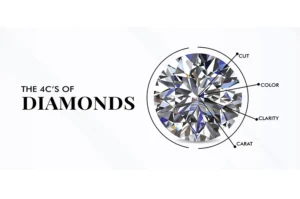
4C of a diamond is a series of standards compiled by Gemological Institute of America (GIA) to assess diamond quality. These four parameters cut, color, clarity and carat determine a diamond’s beauty, rarity and value in conjunction.
Cut
The cut of a diamond is a matter of quality. Brightness, scintillation and fire are all teminologies used to describe how a diamond interact with light. Diamond cut grades ranging from Excellent to Poor are created for round brilliant cut diamonds only due to their distinctive and standardized facets. Other diamond shapes like marquise, emerald, pear, oval, hearts and even triangles are referred to as fancy shapes. Only polish and symmetry are evaluated and listed on their grading report, in contrast to comprehensive cut grades issued for round brilliant cuts.
In addition to proportions referred in the diamond anatomy part, polish and symmetry are two remaining factors that influence cut grades of diamonds. Polish is used to describe the smoothness or marks on a diamond’s facets. Symmetry refelects the geometry, alignment and proportional balance of facets.
Both of them are graded on a scale from Excellent to Poor. Diamonds assigned Excellent or Very Good in polish possess blemish-free facet surfaces serving to maximize light transmission and creating sharp, mirror-mirror like reflections. Naturally, obvious scratches, nicks, pits, burn marks or uneven facet all lower polish grade of a diamond.
Diamonds graded as Excellent or Very Good in symmetry feature well-proportioned, aligned and angled facets edirect and bounce light throughout the stone. Poor symmetry compromises light transmission and reflection, being one of the root causes of dull appearance viewing from the table. Potential triggers of the issue include off-center table, uneven facets or a wavy girdle.
Color
Color of white lab grown diamonds scales from D (completely colorless) to Z (light yellow or brown). Most white lab-grown diamonds follow this standard strictly. One critical point buyers must know: many lab diamonds carry secondary subtle tints like bluish, greenish, grayish, or yellowish. Both IGI and GIA certificates may note abnormal tints in the comment section, using words like grayish, greenish, bluish, or yellowish to hint hidden off-color undertones.
Clarity
Clarity is used to evaluate the degree of diamond purity. Its scale ranges from Flawless (FL) to Included (I3). Both HPHT and CVD lab diamonds come with inclusions and blemishes. Metallic flux inclusions of iron, nickel and cobalt are signature inclusion within HPHT diamonds; dark graphite pinpoints, cotton-like flocculent clouds and zigzag feather fractures dominate internal imperfections.
Carat
Carat is a diamond’s metric weight staying in consistent use since the 1500s. And one ounce weigh around 142ct. Current 1ct equals to 200 milligrams or one-fifth of a gram, and it could be divided into 100 points. A 0.5ct diamond is labeled as 50-point, too. Carat weight of lab diamonds is closely related to retailing prices. The larger the carat weight, the higher its price on condition that other three Cs are identical.
Consumers are more likely to make correct decisions upon deep insight into in and out of synthetic diamonds. Pick up right stones for your customized jewelry in light of structural makeup and distinctive characteristics of diamonds.