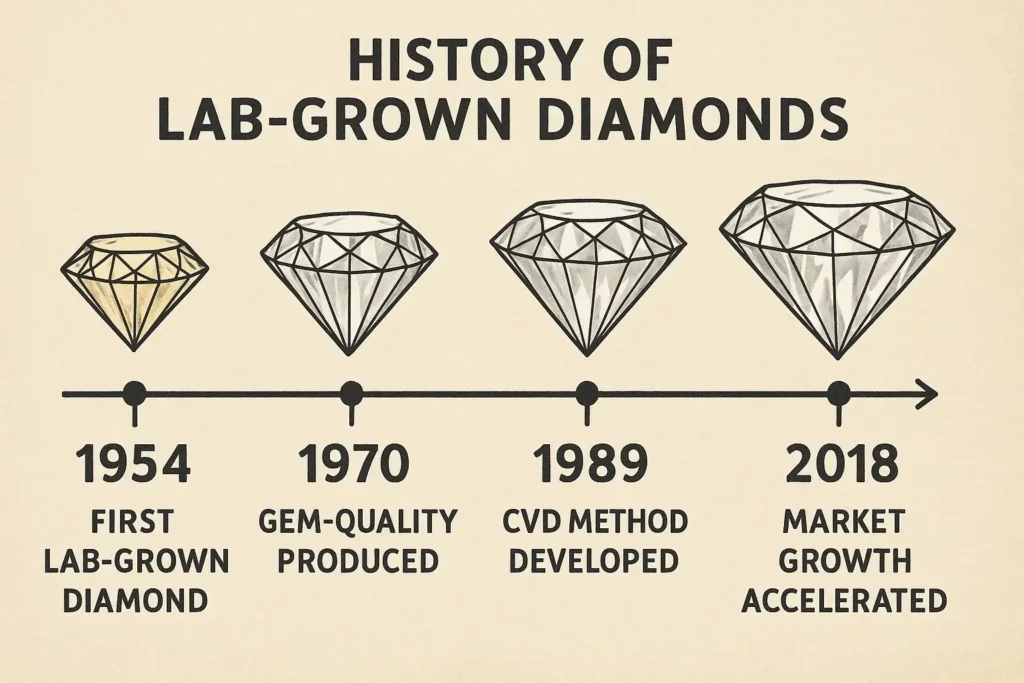
Lab grown diamonds were born in 1954 by General Electric (GE) for the first time in a project start from the 1940s. People have carried out numerous attempts in diamond creation since nature as pure carbon were figured out by Antoine Lavoisier in 1772. Two renowned scientists Howard Tracy Hall and Herbert Strong are credited for outstanding contributions to lab grown diamond creating. They created the recognized lab grown diamonds through a high-pressure belt press, namely the well-known HPHT method.
Development History of Lab Grown Diamond Industry
Born of Lab Grown Diamond Technology
In 1953, Sweden’s ASEA produced the first small synthetic diamonds using HPHT (high-pressure, high-temperature) method. In 1954, GE’s Tracy Hall achieved reproducible HPHT diamond synthesis, announcing the result in 1955. In 1952, the CVD (chemical vapor deposition) concept was introduced, laying the foundation for later low-pressure growth.
Quality Breakthroughs in Early Stages and Industrial Applications
The 1960s were dominated by industrial-grade diamonds for cutting, drilling, and abrasives. In 1963, China synthesized its first diamond. In 1970, GE produced the first gem-quality lab-grown diamonds, though not mass-produced at the time.
CVD Maturity & Commercial Gem Production
The 1980s saw steady improvement in HPHT yellow/brown gem diamonds. CVD technology matured in the 1990s, enabling larger, higher-quality crystals with better color control.
Colorless & Large-Carat Breakthrough
The 2000s brought consistent colorless CVD diamonds. By the mid-2010s, commercial quantities of colorless, jewelry-grade lab diamonds entered the market, with both HPHT and CVD widely adopted.
Mainstream Acceptance & Global Expansion
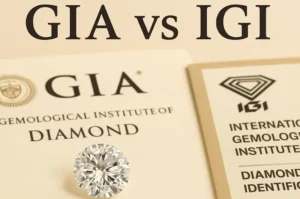
Since 2020, grading labs (IGI, GIA, NGTC) have standardized certification for lab-grown diamonds. Production scaled rapidly, prices became more accessible, and consumer demand surged, especially in the U.S., China, and Europe. The industry is now defined by sustainability, affordability, and ethical sourcing.
Current Status Disclose of Lab Grown Diamond Market
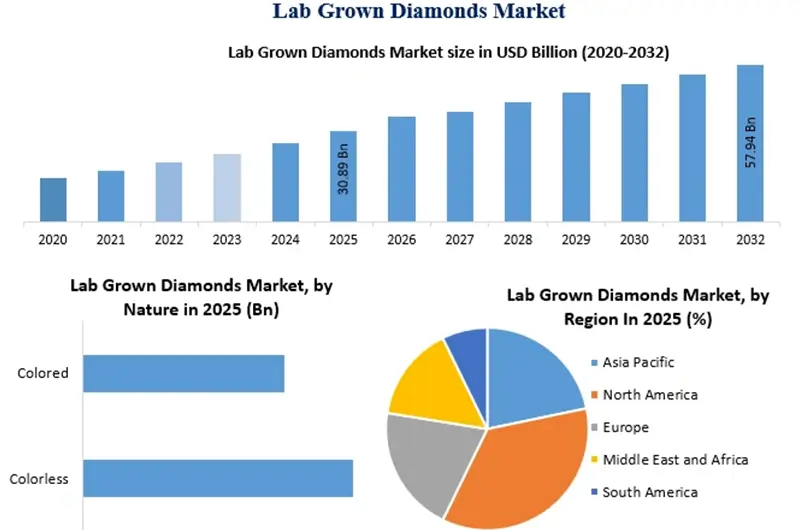
It’s estimated that the lab diamond market will grow from $33.54 billion in 2026 to $91.85 billion by 2034, showing a compound annual growth rate of 13.42% in the period. The 2026 market value is projected to reach USD 30.1–33.5 billion, representing an annual growth of 8% to 14%.
Lab grown diamonds are produced using Chemical Vapor Disposition (CVD) or High Pressure High Temperature (HPHT) technology. Premium lab diamonds could be created in laboratories within a few months while natural diamonds require thousands of years to be formed. Those multi-functional synthetic diamonds have been applied to various applications, such as wholesale lab diamond jewelry, cutting tools and machinery components, etc.
Global Market Share
The value of global lab grown diamond [LGD] market grows up to about 20% of the overall diamond market across the whole world. Its global revenue makes up to $28 ~ $30 billion and will show an upward trend in subsequent decades. In the past decades, the industry has witnessed technological shifts, production cost reduction, production efficiency improvement and consumer psychology transition.
Jewelry market also witnessed spikes in sales of lab grown diamond jewelry, accounting for approximately 42% of all diamond jewelry sold worldwide. Bridal lab diamond jewelry lines take up 48% – 50% market share of all engagement rings in the USA; other jewelry pieces like earrings, bracelets and fashion rings occupy 22% of the lab grown market share.
LGD Market Distribution
By Region
Asia-Pacific takes a dominating position for its the largest global volume and revenue share 34% – 40%. The region functions as the primary production center by virtue of LGD industrial cluster. China, home of lab grown diamond manufacturers and lab grown diamond jewelry manufacturers, produced and supplied about 50% global LGD and related jewelry alone. Nevertheless, North America stands as the primary demand market and its share accounts for about 40% of global lab diamond jewelry market, driven by robust demands in bridal jewelry consumption and United States retail giants.
By Technology
HPHT occupies about 54% of the market share. Mass-volume melee lab diamonds and larger high-clarity rough crystals are produced through the technology; CVD accounts for the remaining 45%. Low energy consumption and effectiveness in growing premium colored lab diamonds contribute to the higher Compound Annual Growth Rate (CAGR). In other words, colored lab diamonds gain growing popularity over decades of development.
By Diamond Carat Weight & Color
Pieces weighing up to 2 carats take over 70% of the market share, favored for their accessible price and suitability for everyday jewelry. Meanwhile, falling wholesale prices have driven a sharp sales increase in center stones ranging from 2 to 4 carats. Colorless diamonds remain mainstream, accounting for 69% of the market. Colored lab-grown diamonds including pink, blue and yellow varieties make up the remaining 31%, delivering faster profit growth for niche jewelry sellers.
Market Preferences of Consumers by Country
As the largest demand market, consumers from the U.S. prefer high carat weight lab diamonds within a certain budget. Young consumers’ demand in engagement rings dominates the bridal market. More than 50% of engagement rings embedded with lab grown diamonds. Most consumers prefer colorless and eye-clean round, oval or radiant cut stones within 2-4 carat weights. Demand for trendy accessories including tennis bracelets and stud earrings sees a sharp uptick.
Indian consumers prefer modern diverse design and cost-effective daily-wear luxury, especially high-carat jewelry pieces as festival or wedding gifts for modern bridal neckwear. LGDs serve as secondary lightweight accessories, compared to traditional heavy gold jewelry. The trend is driven by dedicated lab-grown fine jewelry brands targeting tier-1 and tier-2 cities.
Consumers in Western European countries like UK, Germany and France value environmental transparency, low-carbon certification and heritage craftsmanship, holding strict standards regarding product origins and ethical source. They tend to opt premium and luxury fashion jewelry, but more conservative than Americans in taking them as core bridal jewelry. Modest carat size 1-1.5ct with flawless cut and high clarity are popular choices for most Western European consumers.
Japanese is comparatively conservative in jewelry size and prioritizes subtlety and perfection. Therefore, low-profile minimalist jewelry features flawless craftsmanship and high clarity lab diamonds are popular in the country. Japanese buyers heavily emphasize the highest grading categories in clarity (VVS1+) and cut (Excellent/Ideal), prioritizing microscopic perfection over a larger footprint.
Growth & Restraining Factors Shaping the Lab-Created Diamond Industry
Growth Factors
Drastic price-per-carat of mined diamonds drives more retail buyers choose lab grown diamonds at affordable prices and keep identical visual effects. Cost-effective lab diamonds expand selections of budge-sensitive consumers who can bypass traditional budgetary limits to purchase larger stones 2-4ct for bridal settings. Ethical and eco-friendly source is one another factor prioritized by younger Gen-Z and Millennial cohorts who would like to encourage conflict-free and traceable supply rather than open-pit mined stones.
More independent jewelers and fashion jewelry brand owners have integrated lab-grown inventory to speed up velocity of higher retail transaction. Supreme heat dissipation properties leave them a great choice in industrial semiconductors, thermal management tools, and optics.
Restraining Factors
Sharp price slumps and shrinking profit margins stem from fierce competition driven by booming production equipment in China and India, with wholesale prices plunging as much as 96% since 2018 and retail rates still lacking a bottom line. Lab-grown diamonds fail to retain long-term resale value due to no natural geological scarcity, leading most jewelers to reject repurchases and triggering consumer concerns over value preservation. High energy consumption for CVD and HPHT production further burdens manufacturers amid rising power expenses, while regional overproduction worsens market pressure. Natural diamond groups also launch large-scale promotional campaigns to highlight their luxury and rare attributes as competitive countermeasures. Besides, steep price declines leave retailers bearing huge losses from depreciating unsold stock, demanding tight and fast-cycle inventory management.
Where to Buy Lab Grown Diamonds Wholesale?
WholesaleLab-GrownDiamonds.com is an online website specializing in wholesale lab grown diamonds, wholesale lab diamond jewelry, wholesale lab gemstones and wholesale lab gemstone jewelry, etc. All above product and services are provided by the manufacturer or factory directly at competitive wholesale prices. Click about us page and know more about our information and business scope. Reach out instantly if you would like to get more info or professional suggestions.
How to Buy Lab Grown Diamonds Wholesale?
Wholesale lab grown diamond & jewelry procurement needs a systematic strategy to verify quality, negotiate on competitive pricing and avoid rapid market price dropping. Make a procurement plan and define specific inventory needs prior to reach out to lab grown diamond manufacturers. Loose memo or calibrated parcels by total carat weight means different model. It’s recommended to establish long-term partnership with manufacturer or factory in tech-manufacturing provinces in China. Besides, reputable third-party certification is inevitable across the whole procurement process. IGI is regarded as an undisputed market leader for lab grown diamond grading.
After decades of technological evolution, the lab-grown diamond industry has achieved remarkable commercial growth and enjoys broad global market demand. Favored for affordability, ethical merits and diverse styles, the market size will keep expanding steadily. Regional consumption habits and two mainstream production technologies shape segmented market patterns. While booming jewelry and industrial applications fuel development, the sector confronts hurdles like falling prices, poor value retention and fierce rivalry. With standardized grading and mature wholesale trade, solid supplier partnerships and prudent inventory control will help businesses grasp opportunities and tackle risks.