For jewelry wholesalers, retailers, and brand operators, distinguishing between gold surface finishing techniques is essential for accurate product positioning, transparent customer communication, and reasonable pricing strategy. Understanding gold filled meaning, gold vermeil meaning, and gold plating meaning helps industry practitioners avoid quality disputes, select suitable materials for target customer groups, and effectively identify counterfeit gold-coated jewelry.
What Is Gold Filled Jewelry?
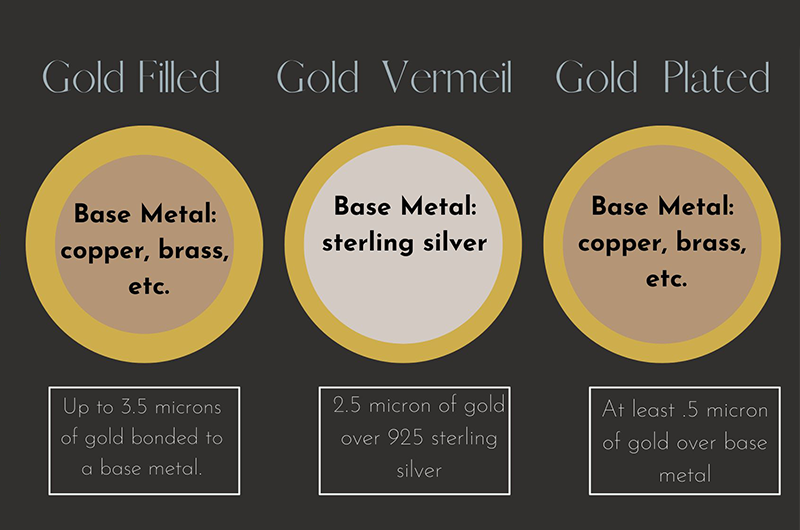
Based on professional gold filled meaning, gold filled jewelry is a high-quality layered metal composite jewelry made through strict mechanical pressure bonding technology, rather than traditional electroplating. Different from thin coated jewelry, gold filled products adopt high-temperature and high-pressure physical lamination process, which permanently bonds thick solid gold sheets to the inner base metal (usually high-quality brass).
Industry regulations clearly stipulate that the gold layer of standard gold filled jewelry must account for no less than 5% of the total weight of the finished jewelry. The gold layer is thick, uniform, and integrated with the base metal without peeling or blistering. This material features ultra-high durability, firm metal fusion, and hypoallergenic properties after professional processing. Gold filled jewelry is positioned in the mid-to-high-end bulk jewelry market, suitable for long-term daily wear, and is widely favored by high-quality jewelry wholesale buyers due to its stable color retention and texture. It is far superior to ordinary electroplated jewelry in terms of grade and service life.
What Is Gold Vermeil Jewelry?
The authoritative gold vermeil meaning defines gold vermeil as a standardized thick gold electroplated jewelry with sterling silver as the core base material. To be recognized as qualified gold vermeil jewelry, two mandatory industry standards must be met: the base metal must be pure 925 sterling silver, and the electroplated real gold thickness must reach at least 2.5 microns, which is dozens of times thicker than ordinary gold plating layers.
Gold vermeil perfectly combines the hypoallergenic advantage of sterling silver and the luxurious luster of real gold. The thick gold layer ensures excellent color retention and wear resistance. Different from gold filled’s physical cladding process, gold vermeil adopts precision electroplating technology to deposit dense real gold molecules on the silver substrate. It is a classic mid-grade fine jewelry material, widely used in bridal jewelry, daily fine accessories and customized jewelry. For consumers with sensitive skin, gold vermeil is one of the safest gold-tone jewelry options, and it is also a mainstream high-quality choice for medium-end wholesale jewelry orders.
What Is Gold Plated Jewelry?
The basic gold plating meaning refers to a universal electroplating process that deposits a thin layer of real gold on the surface of various base metals through electrolysis. The base materials of gold plated jewelry are diverse, including brass, copper, alloy, and stainless steel, with no strict restrictions like gold vermeil.
Ordinary gold plated jewelry has an extremely thin gold layer, usually ranging from 0.17 microns to 1 micron. The production process is simple and low-cost, which is the most common gold-tone finishing technology for fast fashion jewelry. Due to the ultra-thin gold layer, the surface gold film is easy to wear, fade and expose the base metal after short-term wear. Gold plated jewelry is positioned in the low-cost and fast-updating jewelry market, suitable for seasonal trend accessories and disposable decorative jewelry, and is the most cost-effective option for large-volume low-end wholesale orders.
Thickness, Cost and Color Retention Time Comparison
The core differences between gold filled, gold vermeil and gold plated jewelry are fully reflected in gold layer thickness, production cost, and color retention cycle, which directly guide wholesale material selection:
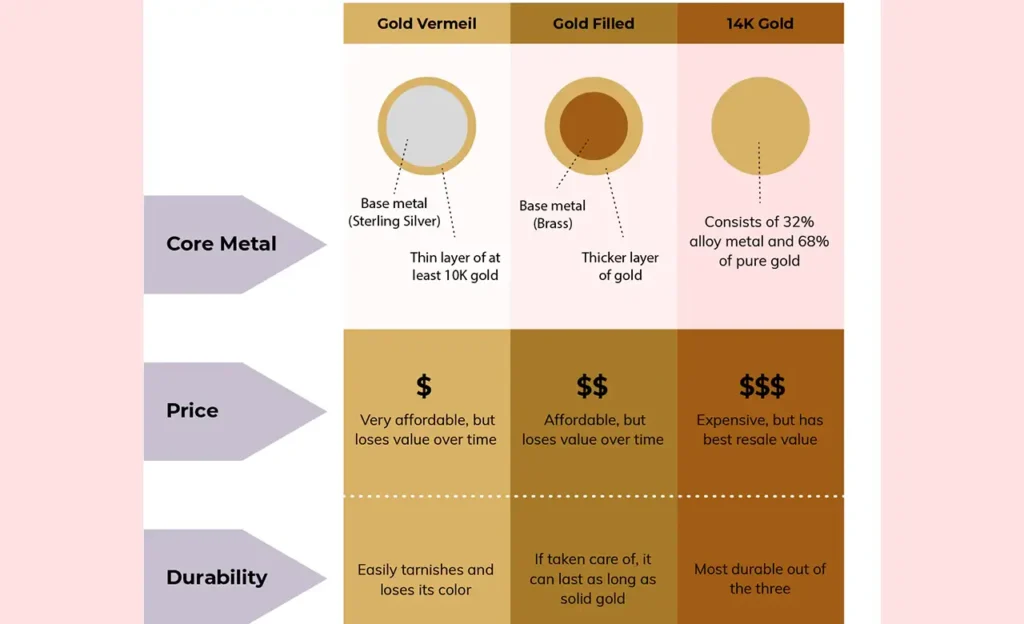
Gold Layer Thickness: Gold filled has the thickest solid gold composite layer (counted by weight ratio, far exceeding electroplating thickness); Gold vermeil follows the 2.5μm minimum thickness standard; Gold plated has the thinnest layer, only 0.17–1μm.
Production Cost: Gold filled jewelry has the highest cost due to physical cladding process and sufficient gold weight; Gold vermeil takes the middle level with sterling silver base and thick gold plating; Gold plated jewelry has the lowest cost with ordinary metal base and ultra-thin gold layer.
Color Retention Time: Gold filled jewelry can maintain luster for more than 5–10 years with daily normal wear, hardly wearing through the gold layer; Gold vermeil retains color for 2–5 years, with stable and long-lasting metallic luster; Ordinary gold plated jewelry only maintains color for 1–6 months, prone to obvious fading and darkening.
Stamp Identification Techniques on Above Three Jewelry Types
Professional jewelry stamps are the most intuitive basis to distinguish the three materials, which is an essential identification skill for wholesale buyers and quality inspectors:
Gold Filled Stamps: Common official marks include GF, Gold Filled, and specific karat marks such as 18K GF. Regular manufacturers will clearly stamp the gold content standard to prove compliance with the 5% gold weight regulation.
Gold Vermeil Stamps: Qualified vermeil jewelry is usually stamped with Vermeil, Gold Vermeil, or 925 Vermeil. The 925 mark represents the sterling silver base, which is the core identification feature distinguishing it from other gold-tone jewelry.
Gold Plated Stamps: The mainstream stamps are GP, Gold Plated, and Electroplated Gold. Most low-cost gold plated products only have simple GP marks without karat or thickness specifications, which is a typical identification feature of thin electroplated jewelry.
Are Gold Plated, Gold Vermeil and Gold Filled Jewelry Real Gold?
All three types of jewelry contain real pure gold, none of them are fake gold or alloy paint, but they differ greatly in gold content and gold utilization form.
Gold filled jewelry contains a large amount of real gold in the form of solid gold sheets, with the highest gold proportion and the most stable value. Gold vermeil jewelry is covered with a thick layer of electroplated real gold on the silver base, with guaranteed gold thickness and pure gold quality. Gold plated jewelry also uses real gold as the electroplating material, but the gold layer is extremely thin and the total gold weight is negligible, resulting in low product value.
It is worth noting that none of the three are solid pure gold jewelry. They are all composite materials combining base metal and real gold layer, which is the essential difference from full solid 18K or 24K gold jewelry.
How to Spot Gold-Free Counterfeit Coated Jewelry?
In the wholesale jewelry market, there are a small number of gold-free counterfeit products that imitate golden luster through paint, chemical coating or alloy coloring. Buyers can quickly identify fakes through the following methods:
First, check the official stamp. Formal gold-filled, vermeil and gold-plated products have clear standard stamps, while gold-free counterfeits have no marks or fake vague stamps. Second, observe the wear state: counterfeit gold coating will peel off in pieces and expose the dark base layer in a short time, while real gold layer wears slowly and evenly without peeling. Third, test the texture: real gold-series coated jewelry has delicate and smooth metallic luster, while fake gold has dull, floating and artificial gloss. Fourth, rely on professional testing tools: gold testing pens can quickly verify whether the surface coating contains real gold components.
Choose Suitable Materials Based on Your Target Clientele
Reasonable material selection based on customer positioning is the key to improving wholesale product competitiveness and profit margins:
For high-end customer groups pursuing durability and texture: Choose gold filled jewelry. It is suitable for high-quality daily wear accessories, gift jewelry and long-term stock products, meeting customers’ requirements for high durability and low replacement frequency.
For mid-end customers focusing on hypoallergenic and fine appearance: Prioritize gold vermeil jewelry. The sterling silver base is friendly to sensitive skin, and the thick gold layer ensures high-grade luster, which is very suitable for bridal jewelry, light luxury fine jewelry and customized bulk orders.
For fashion customer groups pursuing trend and cost performance: Select gold plated jewelry. With low cost and diverse styles, it perfectly adapts to fast fashion trend updates, seasonal new products and low-price retail bulk sales, meeting young consumers’ demand for diversified and affordable trendy jewelry.
Whether you need premiumgold filled durable pieces, hypoallergenic gold vermeil fine jewelry, or cost-effective trendy gold plated bulk accessories, we offer customized wholesale solutions for all specifications. Send us your inquiry today to get professional material recommendations, competitive factory direct pricing, and detailed product spec sheets to elevate your jewelry business lineup.