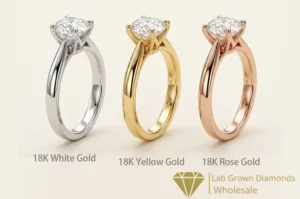
Engagement rings symbolize thresholds of bridal shoppers while most retailers fail to attract those clientele and capture follow-on bridal spend. In general, existing customers spend 67% more than new customers. New customers require 5-7x higher cost than retaining existing customers. Therefore, all existing customers deserve long-term retention for further profit lifting. Data indicates that every 5% retention can lift profitability by 25-90%. What kind of sourcing portfolio are beneficial to retailers for higher repeat purchase rate and profit margins?
The Wedding Bands
Wedding bands are the first and most predictable upsell after a ring sale, and the numbers back that up. 61% couples will buy engagement bands and wedding bands from same store or retailer while the rest 39% purchasing bands elsewhere mean great potential of growth room. Those styles that turn fastest are not the ornate ones. Comfort-fit plain bands in 14k yellow gold, slim milgrain edges and low-profile textured finishes outsell heavy carved designs roughly three to one in our order books. The buying logic is simple: men’s bands are chronically under-merchandised, so a curated run of eight to twelve core male SKUs in sizes 7–13 fills a gap most competitors ignore.
This is where fine bridal jewelry gets its repeat velocity. Brides choose their band metal to match the engagement ring, so keep your wedding band offerings aligned with the same alloys — 14k, 18k, platinum, and now a steady stream of palladium and titanium requests. Your wholesale bridal jewelry purchase should follow that sequence: start with a tight band capsule, then let band sales tell you which metal and width profile your local clientele actually buys. A production partner can hold your band inventory in mixed sizes and engrave inside-stone and date markings before shipment, which cuts your bench time and gives customers a reason to buy from you instead of a chain store.
Wedding Day Gifts
Brides treat the ceremony as a separate budget line. The 2025 bridal report notes that 41% of brides allocate money specifically for wedding-day earrings, pendants and cuffs beyond the ring spend — money that currently flows to bridal salons and department stores if your cases are empty. The winning SKUs are convertible pieces: pearl studs with detachable drops, a pendant that sits on a chain long enough for daily wear, a cuff that works with a sleeveless gown and a blazer later. One-event-only statement sets die on shelves; convertible designs sell twice.
For a jewelry store owner, this category is also the easiest place to raise basket size without adding SKU count. Affordable bridal jewelry with strong plating and hollow-back construction hits the $90–$250 gift band that wedding-party buyers pay without hesitation. Add parent gifts and groom accessories on the same display: signet rings, cufflinks, lapel pins. Wedding-party purchases often come in quantities of four to eight, which turns one bridal customer into a small wholesale order overnight.
Eternity & Anniversary Bands
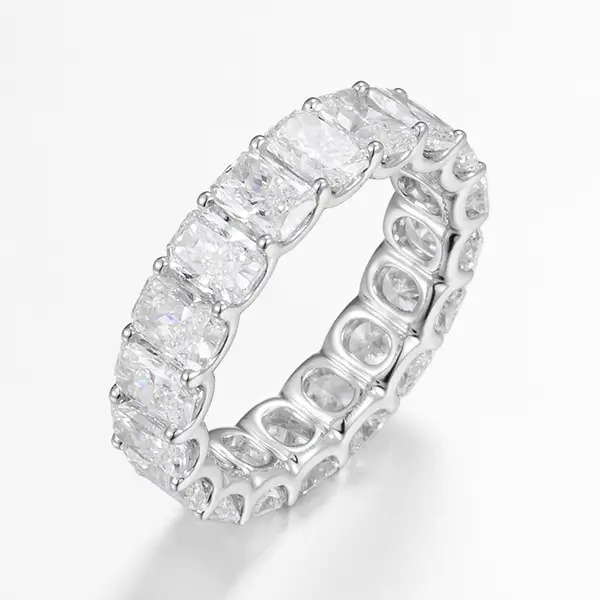
Eternity bands are your long-cycle repeat engine, and the timing is more predictable than most retailers assume. Industry tracking through Platinum Guild International and JCK shows most eternity and upgrade purchases fall in the fifth through twelfth year of marriage, with roughly 37% of couples considering a ring upgrade within the first five years. The customer who bought her band at 26 is a prime eternity-band prospect at 31, at the first child, and again at the tenth anniversary.
Buying strategy favors half-eternity slim stackers over full-eternity pieces: they cost less, fit more finger shapes, and layer beside a wedding band without competing with it. Full-eternity remains a small premium tier for milestone budgets. Because these pieces get bought to match existing bands, your fine jewelry company supply should mirror the metal and profile mix you already sell — that consistency is what makes a second sale feel like a continuation instead of a new search. Automated anniversary outreach is the multiplier here: jewelry CRM benchmarks from platforms like Luxare show anniversary-triggered campaigns converting roughly three times better than generic email blasts, and eternity bands are the highest-margin category in this list, so a 10% lift in conversion is disproportionate profit. Stock them against a projected anniversary calendar from your own sales records, not against gut feel.
Milestone Charm Bracelets & Lockets
Charm and locket lines look small per unit but behave like a subscription. McKinsey’s 2024 luxury pulse survey found that 57% of millennial and Gen Z buyers treat a starter bracelet as a foundation, adding charms for anniversaries, births and travel milestones rather than replacing the piece. That is the exact behavioral loop a retailer wants: a low entry price, then a repeat visit every few months with a predictable spend. The manufacturer side supports this with a modular design — a base chain or locket that stays constant, plus interchangeable charms that refresh the story. You do not need hundreds of charm SKUs; twenty well-chosen motifs (initials, birthstones, hearts, zodiac, engraved dates) cover most purchases.
The economics favor this category for stores testing new lines with limited capital. Affordable fine jewelry no minimum order wholesale lets you bring in a starter run of lockets and a matched charm set without committing to a full collection — exactly the low-risk entry that milestone pieces deserve, since they sell year-round rather than peaking in wedding season. Engravable lockets also create a service touchpoint: an in-store engraving desk or a fast factory turnaround on engraved plates turns a commodity sale into a keepsake, and keepsakes generate referrals. Track charm add-ons as a separate loyalty metric; a customer who returns for a second charm is measurably more valuable than a one-time bridal buyer.

Data-Driven Inventory & Merchandising Framework for Store Owners
The discipline that separates profitable stores from overloaded ones is concentration. Jewelers of America inventory guidance and independent retail coaching data converge on the same rule: allocate roughly 75–80% of your non-engagement bridal buying budget to these four categories and retire anything that has not sold in 90 days. Curated assortments with 30–40% fewer SKUs routinely lift average transaction value by around 20% because staff sell what they actually know. The targets are trackable, too. Wedding bands should attach at 60% or higher during engagement consultations. Wedding day jewelry should attach at 22–30% once a band is chosen. Eternity and anniversary bands are a nurture-led conversion you measure annually against your own bridal database. Charm systems should attach at 15–20% at the wedding sale, with incremental charm sales counted on a rolling 12-month basis.
Your wholesale strategy should follow the same math. Order in tiers, not in breadth: entry price points for impulse buyers, mid-tier for the bulk of volume, and a small premium shelf for margin. A wholesale strategy for retail brand growth works best when it is written around your attach-rate goals rather than around a catalog — pick a manufacturer who can mix metals, batch sizes and white-label packaging on one purchase order. This is also where buying online pays off. Working with wholesale fine jewelry distributors who publish real-time stock, ship from a domestic or bonded warehouse, and quote consistent grading means you can restock a proven bestseller in days instead of waiting out a seasonal show cycle. Test new styles in batches of three to five units; once a style clears its first 90 days, promote it to a standing reorder.
When you build this range, you are not chasing trends — you are converting couples who already bought from you into multi-year clients. Each band, wedding-day gift, eternity piece and charm becomes a scheduled future purchase that you can predict, stock and sell with data instead of instinct.
Work directly with our factory to customize these designs under your own brand, or pull from our in-stock lines to make preparation for follow-on purchases. Request for better solutions now.