Different jewelry finishes determine the final appearance and brand positioning to a great extent. They transform raw materials to wearable, textured, and stylized accessories. Even a subtle change in surface texture can alter the visual tone, tactile experience, and market competitiveness of a jewelry piece. It’s essential to master diversified surface finishing methods and matching suitable craftsmanship for fine jewelry brands to building unique brand recognition.
What Are Jewelry Finishing Techniques
Jewelry finishing techniques refer to a series of professional metal surface treatment processes implemented after jewelry molding, trimming, and polishing. These processes modify the surface microstructure, light reflection effect, color tone, and tactile texture of precious metals such as gold, silver, and brass, turning rough semi-finished products into finished jewelry. Professional finishing focuses on finishing jewelry techniques that shape fixed stylized textures and durable surface effects.
Importance of Jewelry Finishing Techniques
The value of jewelry finishing techniques runs through product quality, user wearing experience, and brand market differentiation. A uniform polished surface presents a luxurious and bright feeling, while a matte textured surface delivers a low-key and advanced minimalist style. Exclusive finishing texture can form a unique visual symbol of the brand. Many mature jewelry brands rely on fixed metal finishing styles to let consumers quickly identify brand characteristics, avoiding homogeneous competition with generic market products.
Regular Types of Jewelry Surface Finishes & Texture
Different surface finishes and textures correspond to distinct wearing scenarios, crowd positioning, and design styles. Each process has unique production characteristics, tactile effects, and aesthetic advantages, providing unlimited customization possibilities for brand product development. The mainstream surface finishing types widely used in the jewelry industry cover smooth matte treatment, linear brushed texture, manual hammered surface, sandblasted treatment, vintage oxidation, and professional color plating, etc.
Smooth & Matte Finishes
Smooth and matte finishes are the most classic and versatile surface treatments in modern jewelry manufacturing, favored by minimalist and high-luxury brands. Smooth high-polish finishing adopts multi-layer fine grinding and mirror polishing technology, which removes all surface unevenness and forms a flat and smooth metal surface with strong light reflection. Jewelry with smooth finishes is bright and delicate, suitable for formal occasions and high-end custom accessories, showing a neat and luxurious temperament.
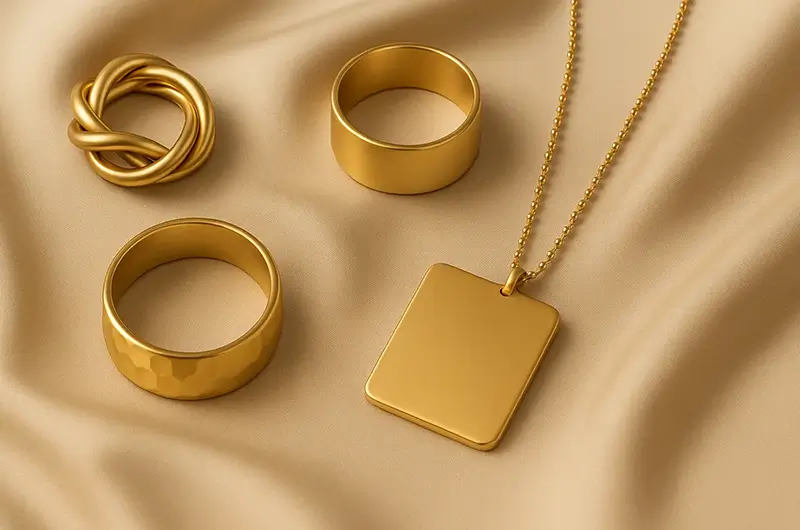
Matte finishes abandon excessive light reflection and form a soft fog surface through fine surface atomization treatment. This process weakens the luminous metal finish, creating a gentle and low-key advanced texture that cover tiny wearing scratches. As one of the most practical types of metal finishes for jewelry, smooth and matte finishes can be switched and combined according to brand design needs, meeting the customized needs of daily casual wear and business formal wear jewelry.
Brushed Linear Finishes
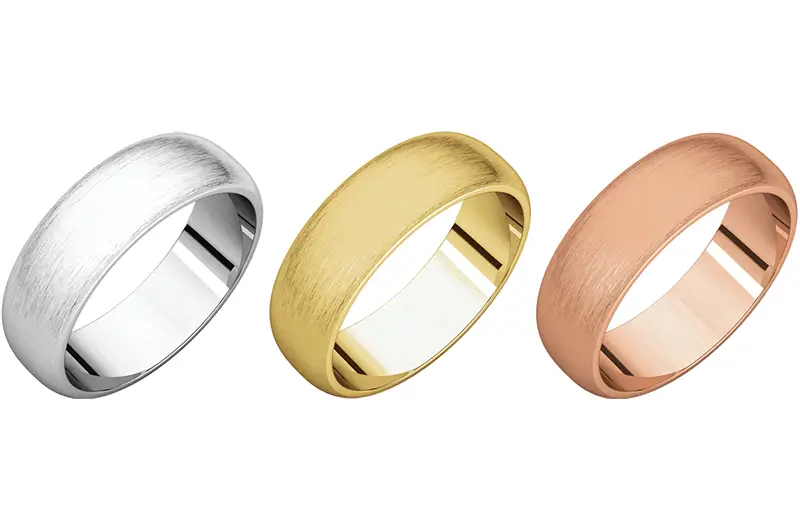
Brushed linear finishes are iconic texture treatments that balance simplicity and texture, being one of popular options for daily jewelry. The process forms continuous and uniform linear textures on the metal surface through professional wire drawing equipment or manual polishing, including fine brushed, coarse brushed, and radial brushed effects. The delicate linear texture works in weakening the gaudy sense of pure gold, endowing gold jewelry with a modern, minimalist and sophisticated texture.
Brushed linear finishes excel in hiding subtle scratches. Friction and abrasion caused in daily wear are inconspicuous in general. The technique allows you to adjust the thickness and direction of fine jewelry textures on rings, bracelets, necklaces and other accessories to form exclusive linear texture characteristics.
Hammered Surfaces
Hammered surface finishing is a traditional handmade jewelry process with strong artistic sense and uniqueness. The production process relies on precise manual or mechanical hammering to form regular or irregular concave-convex dot textures on the metal surface. Each hammer mark forms an independent light-reflecting surface, making the jewelry present a layered and flexible sparkling effect under light.
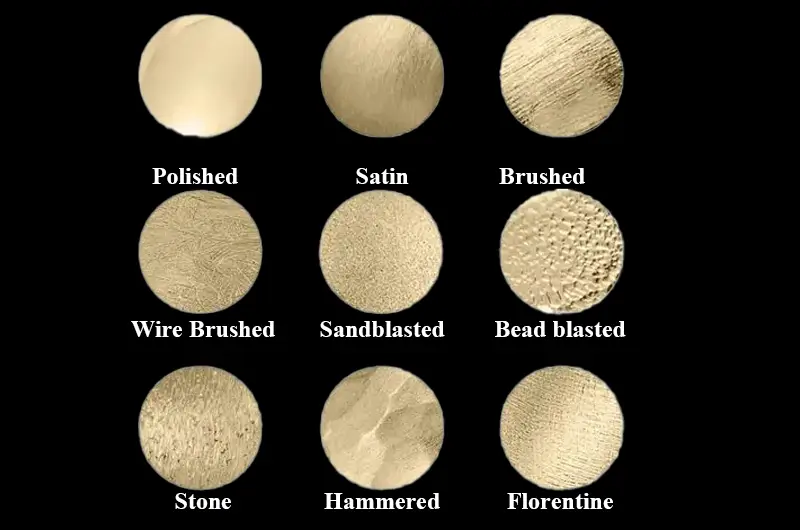
A hammered finish jewelry features strong handmade texture and zero homogeneity, which is very suitable for retro, ethnic and niche designer jewelry styles. Different from mechanized uniform textures, hammered surfaces have subtle artificial traces, which highlight the uniqueness of customized jewelry. This process can be applied to silver, brass and titanium steel jewelry. After matching with subsequent oxidation or polishing treatment, it can present diverse style changes, helping brands create personalized handcrafted product series.
Sandblasted Jewelry Finish
Sandblasted finishing is a professional fog surface treatment process, in which fine sand particles are sprayed on the metal surface by high-pressure equipment. Then a dense, uniform, fog and concave surface is formed. For the sake of finer particles on surfaces, sandblast surface finishes bring out more textural details than ordinary matte finishing. The sandblast finish is suitable for minimalist jewelry and mens jewelry for superior performance in keep the surface clean without obvious fingerprints and scratches.
Oxidized & Vintage Finishes
Most retro jewelry finishes are engineered through oxidization, in which appearance of jewelry are transformed and diversified greatly. Professional chemical oxidization and aging treatment induces natural tonal degradation and an aged aesthetic on metal jewelry surfaces. An oxidized finish jewelry takes advantage of the color difference formed by oxidation gaps. The concave parts of the jewelry will form dark vintage tones, while the raised parts retain the original metal luster, perfectly restoring the retro texture of old-fashioned handcrafted jewelry.
Plating & Color Modification Techniques
Plating and color modification techniques are important supplementary finishing processes for jewelry surface styling, which realize colorful and diversified metal color presentation on the basis of shaping basic textures. Common processes include rhodium plating, gold plating, black ruthenium plating, and PVD vacuum coating. These technologies can not only change the surface color of metal, but also form a protective film on the jewelry surface to improve oxidation resistance and corrosion resistance.
Impacts of Jewelry Finishing Techniques on Manufacturing Cost
Different jewelry finishing techniques bring obvious differences in manufacturing costs, which is an essential factor for brands to consider in product pricing and line planning.
Basic smooth polishing and conventional matte finishing adopt fully mechanized assembly line operation, with simple production steps and low time cost, so the overall manufacturing cost is relatively low, suitable for mass-produced basic jewelry products.
Processes such as fine brushed, uniform sandblasting and conventional oxidation belong to mid-cost finishing technologies, which require standardized parameter adjustment and manual fine inspection, with moderate cost and high-cost performance, suitable for most light luxury customized jewelry.
In contrast, handmade hammered, gradient oxidation and multi-layer composite plating processes require a lot of manual operation and repeated process debugging, with complex production procedures, high scrap rate and long production cycle, resulting in higher manufacturing costs.
How Professional Finishing Strengthens Brand Perception
Professional and standardized jewelry finishing is an invisible business card for jewelry brands to enhance market reputation and user trust. In the consumer market, most users cannot accurately distinguish jewelry materials, but they can directly perceive the product grade through surface texture, smoothness and wearing feel. Brand products with uniform and delicate finishing textures can bring consumers a high-quality, professional and reliable consumption experience, effectively improving user recognition and repurchase rate. In addition, exclusive customized finishing textures can form unique brand visual labels.
Choosing the Right Jewelry Finishing Techniques for Your Brand
Selecting targeted jewelry finishing techniques is critical for brand personalized customization. Besides, other factors like brand positioning, target consumer groups, product applications and market trend preferences should be taken into considerations, too. Last but not least, cost and quality control are essential for brands to ensure pleasing appearance while maintaining stability in mass production.
If you want to build exclusive brand-style jewelry and stand out in the homogeneous market, our professional customization team can tailor exclusive surface schemes for you by integrating diverse jewelry metal finishes. Whether you need delicate brushed gold finish, textured sandblast surface finish, retro oxidized finish jewelry, or artistic hammered finish jewelry, we can perfectly restore your brand design ideas. Customize unique brand-inspired jewelry with multiple types of metal finishes for jewelry to create personalized high-quality accessories exclusive to your brand!