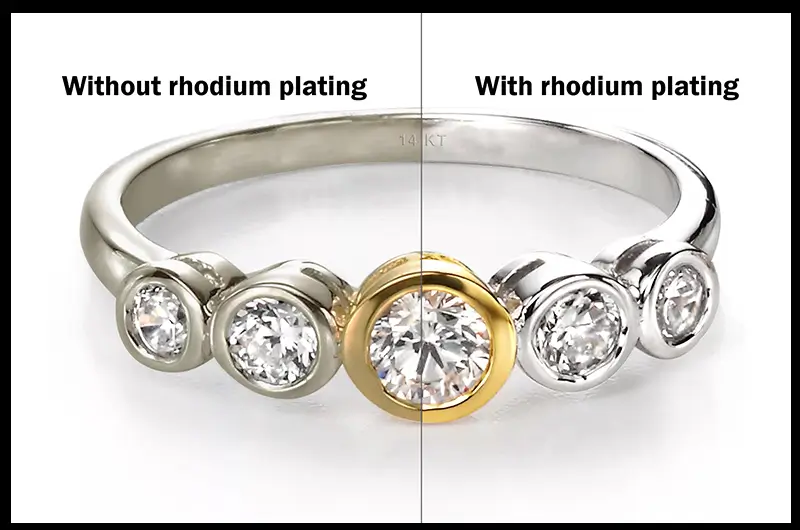
In the competitive fine jewelry manufacturing industry, white gold products remain a mainstream choice for daily wear and high-end customized accessories, favored by global consumers for their elegant luster, stable texture, and affordable premium positioning. However, surface wear and luster fading have long been the most prominent quality pain points restricting the market reputation and service life of white gold jewelry.The failure of white gold surface protective layers directly leads to increased after-sales maintenance costs, reduced customer trust, and weakened product market competitiveness. Most white gold alloys are composed of gold mixed with nickel, palladium, or silver, which naturally present a faint yellow tint and are prone to oxidation, discoloration, and skin allergy after long-term wear. To solve these defects, rhodium plating for white gold has become a standardized finishing process in fine jewelry mass production, serving as a key process to brighten surface luster, isolate alloy impurities, and improve wear resistance.
Despite the wide application of rhodium plating technology, manufacturers still face universal technical dilemmas in actual production. The most common problem is white gold plating wearing off after short-term daily wear. Fine jewelry such as wholesale men’s diamond rings, wedding bands, and daily wear white gold pendants often suffer from coating peeling, partial abrasion, and luster dimness within 3 to 12 months of consumer use. This issue is particularly prominent in wholesale order products, which are produced in large batches and have stricter cost control, making unstable plating quality a major factor in customer complaints and order returns. Based on years of electroplating production experience, this article systematically analyzes the key factors affecting the wear resistance of white gold rhodium plating, explores scientific parameter control standards, and introduces composite wear-resistant coating solutions combining traditional electroplating and modern PVD technology, providing practical technical guidance for standardized and high-quality production of fine jewelry manufacturers.
Key Factors Causing White Gold Rhodium Plating Wear Failure
To develop targeted wear-resistant solutions, manufacturers must first clarify the core reasons for coating wear and peeling. The wear resistance of white gold rhodium plating is affected by multiple dimensions including process parameters, pre-treatment technology, coating material characteristics, and post-production processing. Among them, plating thickness and electroplating process precision are the two most critical determinants.
Rhodium plating thickness is the primary technical index that determines the service life of white gold plating. In the fine jewelry industry, the conventional rhodium plating thickness ranges from 0.1μm to 0.5μm. In traditional low-cost batch production, many manufacturers adopt a thin plating process below 0.2μm to save raw material costs. Although this process can form a bright and uniform white coating on the surface of white gold, the coating is too thin to resist daily friction, scratch, and oxidation erosion. For frequently worn jewelry such as wholesale mens diamond rings, finger friction, contact with clothing, skin sweat, and daily chemical products will quickly wear through the thin rhodium layer, exposing the underlying white gold alloy and causing yellowing and discoloration. On the contrary, excessive plating thickness (more than 0.5μm) will lead to increased coating internal stress, resulting in cracking, peeling, and poor surface smoothness, which damages the fine texture of fine jewelry and increases production costs unnecessarily.
Defects in the electroplating gold jewelry process system are another core cause of coating wear failure. Standard electroplating production includes multiple links such as workpiece degreasing, acid activation, bottom plating treatment, rhodium deposition, and post-plating cleaning and passivation. In actual mass production, many manufacturers simplify pre-treatment processes to improve efficiency, resulting in residual oil stains, oxide layers, and impurity particles on the white gold surface. These hidden defects lead to poor bonding force between the rhodium coating and the base metal. Even if the plating thickness meets the standard, the coating will peel off in pieces under slight external friction. In addition, unstable electroplating current, unreasonable plating solution temperature, and aging plating solution components will cause uneven coating density, loose local structure, and significantly reduced wear resistance. For high-precision fine jewelry with intricate carvings and diamond inlays, uneven current distribution will lead to inconsistent plating thickness at edges and recesses, making these parts the first to wear and fail.
Optimization of Traditional Electroplating Process
As a mature and low-cost surface finishing technology, traditional electroplating still occupies a dominant position in fine jewelry manufacturing, especially suitable for large-batch wholesale orders. For manufacturers, optimizing the traditional electroplating process is the most cost-effective way to improve the wear resistance of white gold rhodium plating without replacing production equipment. Combined with industrial production standards and batch operation experience, we have summarized a set of standardized optimization schemes for plating thickness control and process upgrading.
First, formulate differentiated rhodium plating thickness grading standards according to product positioning and usage scenarios. For lightweight decorative white gold jewelry with low wear frequency, a plating thickness of 0.25μm to 0.3μm is adopted to balance cost and basic wear resistance. For high-frequency wear products represented by wholesale mens diamond rings, the plating thickness is controlled stably at 0.35μm to 0.45μm. This thickness range can effectively resist daily friction and sweat erosion, avoid rapid white gold plating wearing off, and will not cause coating cracking due to excessive thickness stress. In production, manufacturers need to equip professional thickness testing instruments to conduct random inspections of batch products, eliminate unqualified products with uneven thickness, and ensure consistent wear resistance of each piece of jewelry.
Second, standardize the full-process operation of electroplating gold jewelry to improve coating bonding force and density. Strengthen the pre-treatment process: adopt ultrasonic degreasing and multi-stage pure water cleaning to completely remove surface oil and wax stains, and use low-concentration acid activation solution to remove the oxide layer on the white gold surface, ensuring that the base metal is clean and active before plating. Add a thin nickel bottom plating layer between the white gold base and rhodium coating. The nickel bottom layer can fill the tiny gaps on the alloy surface, improve the flatness of the base surface, and significantly enhance the bonding firmness of the rhodium layer. In the electroplating stage, precisely control the current density (0.5-1.2 A/dm²) and plating solution temperature (40-50℃), and regularly replace and filter the plating solution to avoid impurity precipitation affecting coating density. After plating, adopt low-temperature passivation treatment to form a dense protective film on the rhodium coating surface, further improving anti-oxidation and wear resistance.
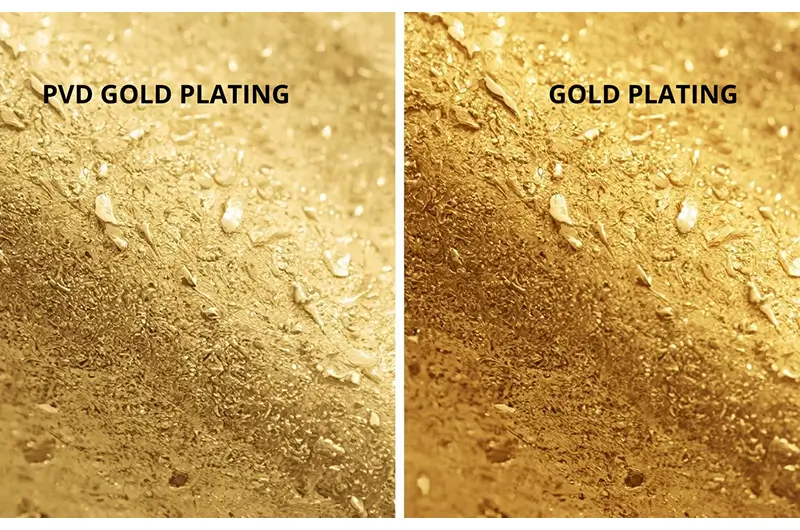
PVD Coating For Jewelry Composite Technology
For high-end fine jewelry customized orders and high-value wholesale products, traditional single rhodium electroplating can no longer meet the market’s high requirements for long-term wear resistance and permanent luster. In recent years, pvd coating for jewelry has become an advanced upgrading technology in the fine jewelry manufacturing industry, solving the inherent wear resistance bottleneck of traditional electroplating and bringing a qualitative leap in product durability.
PVD (Physical Vapor Deposition) coating technology is a physical vapor deposition process that forms a high-density, high-hardness ceramic composite coating on the jewelry surface under vacuum environment. Compared with traditional rhodium plating for white gold, PVD coating has higher hardness, better friction resistance, stronger adhesion, and more stable chemical properties. The traditional electroplating rhodium layer has a Vickers hardness of about 400-500 HV, while the PVD composite rhodium-based coating can reach 800-1200 HV, which can effectively resist daily scratches, friction and metal collision wear. In terms of service life, the wear-resistant cycle of PVD composite coating white gold jewelry is more than 3 times that of traditional electroplating products, fundamentally solving the problem of white gold plating wearing off.
In actual manufacturing production, manufacturers can adopt a composite process of “traditional electroplating bottom layer + PVD top layer” to balance production cost and high wear resistance. First, complete the conventional rhodium electroplating process on the white gold surface to ensure the bright white luster of the jewelry and fill the surface gaps. Then, deposit a nano-scale transparent wear-resistant PVD coating on the electroplated layer surface. This composite structure not only retains the high-grade bright white texture of traditional rhodium plating but also uses the high-hardness PVD coating as a protective barrier to isolate external friction, sweat corrosion, and oxidative discoloration. For core products such as high-end wholesale mens diamond rings, this composite process can greatly reduce after-sales maintenance problems, improve product added value, and help manufacturers occupy the high-end wholesale market.
In addition to excellent wear resistance, pvd coating for jewelry also has obvious advantages in environmental protection and process stability. The PVD process is carried out in a vacuum closed environment, without the waste liquid pollution problem of traditional electroplating gold jewelry, which meets the global environmental protection production standards for fine jewelry. At the same time, the PVD coating has uniform thickness and stable performance, which will not cause color difference or local wear failure due to product shape differences, and is suitable for mass standardized production of various complex-shaped white gold fine jewelry.
Batch Production Quality Control and Wholesale Product Application Strategies
As fine jewelry manufacturers, batch production stability and wholesale product cost performance are the core factors of market competition. On the basis of optimizing wear-resistant processes, standardized quality control and targeted product strategy matching are required to maximize the practical value of wear-resistant solutions. First, establish a full-process quality inspection system centered on rhodium plating thickness detection. Set up three inspection links: pre-production parameter debugging, in-production random inspection, and finished product full inspection. Use professional coating thickness gauges to accurately detect the plating thickness of key wear parts such as ring surfaces, bracelet outer arcs, and pendant edges to ensure that all products meet the customized wear-resistant thickness standards.
Second, formulate differentiated process schemes for different wholesale product categories. For conventional low and medium-end white gold wholesale accessories, optimize the traditional electroplating gold jewelry process, strictly control pre-treatment and electroplating parameters, and stabilize basic wear resistance while controlling costs. For high-end wholesale mens diamond rings and customized wedding jewelry, adopt PVD composite coating technology to create high-durability products, form product differentiation advantages, and increase wholesale profit margins. This differentiated production strategy can help manufacturers cover multi-level market demands and avoid homogeneous price competition.
In addition, summarize production data regularly to iteratively optimize wear-resistant processes. Count the after-sales wear failure rate of products with different plating thicknesses and different coating processes, analyze the wear causes of products in different usage scenarios, and adjust process parameters in a targeted manner. For example, for men’s diamond rings with high friction frequency, appropriately increase the PVD coating thickness and optimize the coating density; for thin and light white gold pendants, appropriately reduce the plating thickness to avoid affecting the delicate texture while ensuring wear resistance.
The wear resistance of rhodium plating is a key index that determines the quality, service life and market reputation of white gold fine jewelry. Solving the problem of white gold plating wearing off is not only a technical optimization demand but also a core link to improve product competitiveness and customer satisfaction.